The 2026 influencer marketing ROI statistics reveal profits that no one expected. Top brands earn $18-$20 for every dollar invested. Yet 53% of marketers still can’t measure their returns properly.
A person can be easily convinced when their favorite creator is promoting the product. That’s why the conversion rate of influencer marketing is at least 1-5% globally. To remain relevant and consistent in this dense competition, influencer marketing becomes necessary.
To make it easier for everyone involved, we’ll analyze conversion rates, compare platform-specific ROI, and explain why vague metrics are the industry’s biggest problem. One section near the end shows a method that predicts campaign success better than reach.
What Is the Average ROI of Influencer Marketing in 2026?
Now, let’s break down the average return on investment in detail.
The Core Numbers
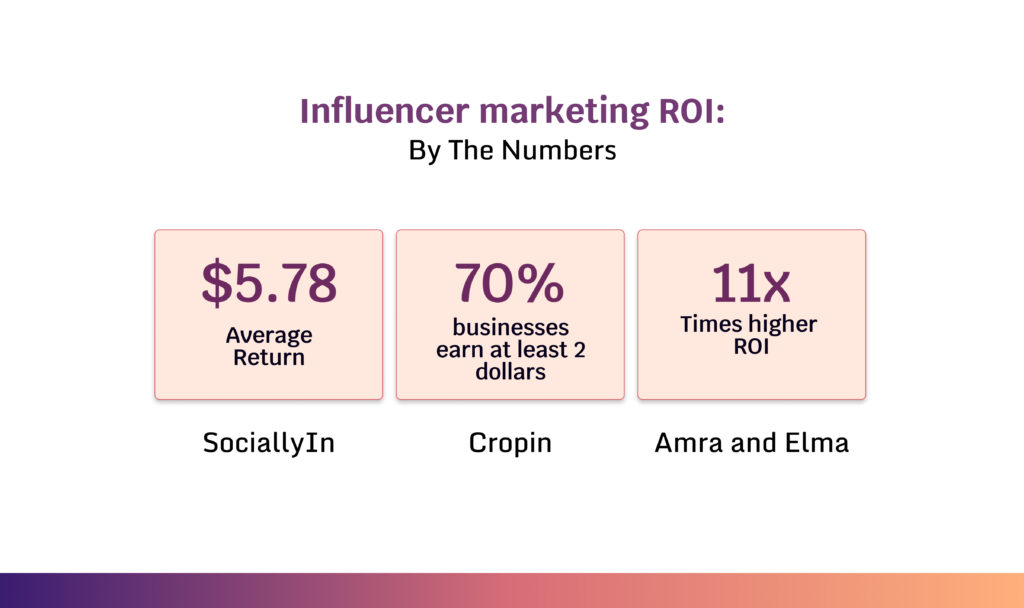
- On average, brands earn $5.78 for every dollar they spend (SociallyIn). This is the industry standard. The profits range from 2x to 20x for top-performing influencer campaigns.
- 7 in 10 businesses earn at least 2 dollars for every buck spent (Cropink).
- Compared to traditional digital advertising, the ROI is 11 times better with influencers (Amra and Elma).
Why the Wide Range Exists
Due to the brands’ marketing budget, the targeted tiers of influencers vary. More tiers mean a wider range of profit for the same campaign. Platform choice also makes a difference in conversion rates.
- TikTok has the highest conversion rate (78%) among all social media platforms. The credit is due to its loyal following, exclusive features, and TikTok Shop.
Get matched with creators that fit your budget and niche within minutes
Get Started Now- Beauty and fashion brands often see more conversions than B2B marketing.
How Brands Actually Calculate ROI
- Newer brands are often the ones doing influencer marketing the most. That’s why 54.3% of brands use views/reach to calculate “return” (Cropink).
- Brands not-as-new but still “small,” like to track engagement metrics (likes, comments, shares): that makes up 23.5% of them (Cropink).
- However, older businesses prefer to see more concrete results. Which means 22.1% brands measure ROI in direct sales/conversions (Cropink).
- According to Markerly (2024), EMV has been an acceptable measurement for a while, since 83% consider it a solid metric of ROI.
It’s Not Black & White At All
- Despite it sounding like everyone has it going for them, 79% still consider measuring ROI their biggest challenge (Linqia). It’s hard to blame them since multi-touch customer journeys are hard to track and measure profit from.
Influencer Marketing Revenue Statistics by Platform
As we mentioned previously, platform differences matter just as much as other factors in influencer marketing ROI. Here we’re representing the three most popular options:
📊 Platform Performance Comparison
| Platform | ROI / Revenue | Engagement | Key Stats | Best For |
|---|---|---|---|---|
| TikTok | 78% conversion rate (purchase after viewing) | 18% (U.S. Avg.) | 50% of marketers cite best ROI; 46.7% call it the most important channel. | Gen Z, trends, impulse buying, viral reach. |
| ~$4.12 return per dollar spent | 40-60% higher on Reels vs. Feed | 57% of brands prefer it for campaigns (2025). | Fashion, beauty, lifestyle, visual aesthetics. | |
| YouTube | 70% conversion rate (intentional purchase) | Highest fan loyalty | 36.7% of brands prefer long-form; ~90 seconds of screentime per video. | Serious/educational content, sponsorships, broad or niche audiences. |
TikTok Influencer Marketing ROI
- 50% of marketers believe that TikTok has the best ROI, and 46.7% are convinced that it is the most important influencer marketing channel (SociallyIn).
- The conversion rate is the brand’s darling, with a whopping 78% of viewers purchasing a product after seeing content from their favorite influencer (Dash.app).
- The U.S. alone has an 18% engagement rate on TikTok, which dramatically surpasses all competitors in the market (Digital Marketing Institute).
- If you want to target as many Gen Zs as possible, create trends, go viral, and trigger impulse buying, TikTok is your best bet.
- The only “downside” is that you have to choose your collaborators carefully, making sure that the creator hasn’t been involved in any scandals, and has never reviewed your product terribly before (look up the Mikayla controversy)
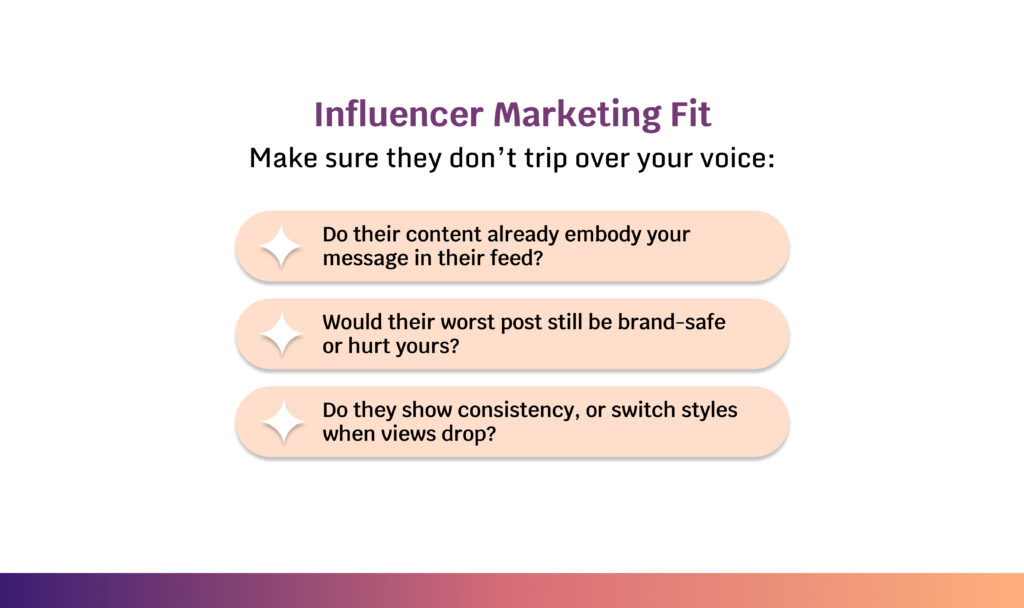
Also, make sure that sponsored content is actually labeled as sponsored content in their posts. Not disclosing ads/paid partnerships is illegal. The influencer checklist applies to all social media platforms.
Instagram Influencer Marketing ROI
Like TikTok, Instagram is also a good place for influencer marketing.
- And there’s a wider variety of brands that work better on Instagram than on TikTok.
- There’s an estimated $4.12 return per dollar spent (Dash.app, 2025).
- Though reported in 2025, 57% brands still prefer Instagram for campaigns for its wider, often higher-quality younger audience (Influencer Marketing Hub).
- Fashion, beauty, and lifestyle collaborations work outstandingly on Instagram. They get the highest engagement.
- Between feed posts and reels, engagement rate is 40-60% higher on reels. But if you’re working with a celebrity, even feed posts will reach the upper end of engagement rates.
YouTube Influencer Marketing ROI
For more serious brands, YouTube is a great place to do “influencer marketing.” They aren’t really influencers in the traditional sense, so it’s safer to call them sponsorships.
- Fandoms have the highest loyalty towards YouTubers than any other platform. Because their relationships are built upon either long-time influence (videos) or memorable popularity (shorts).
- If your brand leans on the broader, more “general,” or even a rather niche side, you’ll find your partner on YouTube. 36.7% of brands prefer long-form content anyway (Influencer Marketing Hub).
- While TikTok viewers convert on impulse, YouTube viewers convert intentionally. A reported 70% of viewers purchase a product/subscription after seeing their favorite YouTuber talk about it (Dash.app).
- Sure, the ad spend can be a bit higher (or free, if you send them enough products), but the results are equally worth it. Especially since you get 90 seconds of screentime per video.
And if you find the results satisfactory, you can even make them your permanent brand ambassador!
Platform Comparison Synthesis
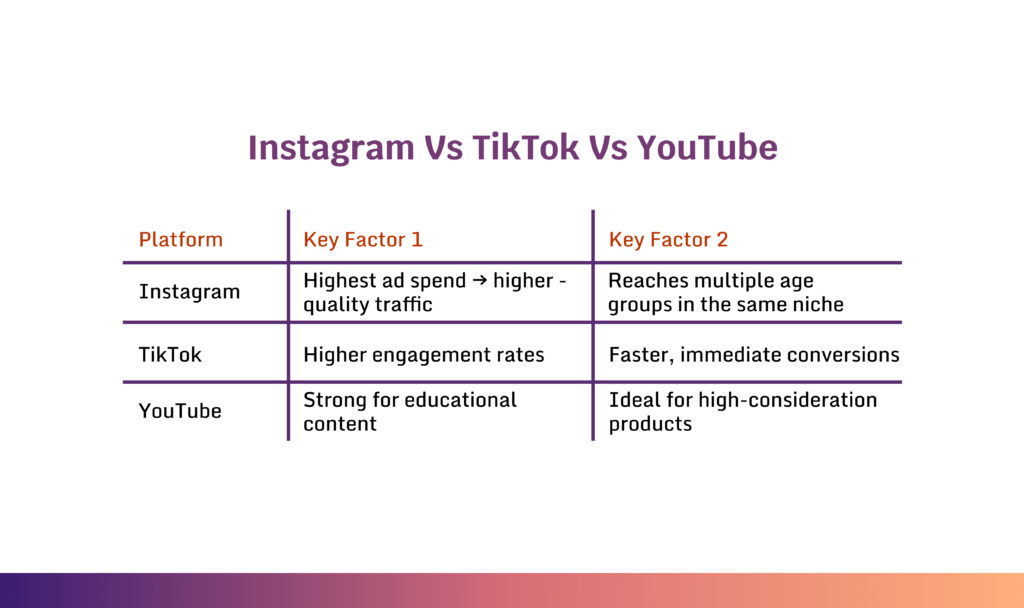
In short:
- Instagram gets the most ad spend (higher quality), even though TikTok often has higher engagement.
- TikTok drives the most immediate conversions; Instagram reaches more age groups in the same niche.
- YouTube is better for educational or high-consideration products.
Choose platforms based on how complex your product is and how long people take to decide.
Influencer Marketing Benchmarks by Creator Tier
At this point, let’s look at the stats based on the popularity or fan size of the influencers.
ROAS by Influencer Size
| Influencer Size | Follower Count | ROAS | Notes |
|---|---|---|---|
| Nano | 10k-100k | 4-7x | Best efficiency; average ROAS is the highest. |
| Micro | 100k-1M | 3.5-5.5x | Solid performance, slightly lower than nano creators. |
| Mid-tier | 1M-10M | 2-3.5x | Respectable, but offers half the efficiency of smaller creators. |
| Macro | 10M+ | 1.5-2.5x | Barely better than traditional advertising despite high cost. |
- The smaller the influencer, the better the ROAS. According to the Archive:
- Nano-influencers with 10k-100k followers deliver 4-7x average ROAS.
- Micro-influencers (100k-1M) produce 3.5-5.5x ROAS. Still solid, just slightly lower than nano creators.
- Mid-tier influencers sitting at 1M-10M followers? 2-3.5x ROAS. Respectable, but you’re getting half the efficiency.
- Macro influencers (10M+) barely hit 1.5-2.5x ROAS. That’s barely better than traditional advertising, despite costing way more.
Why Smaller Creators Outperform
- SociallyIn shows that nano-influencers achieve 10.3% engagement on TikTok vs 7.1% for mega-influencers. That’s a massive gap.
Genuine audience relationships lead to more trust and more conversions. Their followers actually care about what they recommend.
- That’s exactly why 73% of brands prefer working with micro and mid-tier creators when ROI matters.
It isn’t to discount bigger creators altogether. The best approach is to use big creators for brand awareness and micro/nano creators for sales.
Cost-Per-Engagement Benchmarks
| Creator Size | Cost Per Post | Engagement Rate |
|---|---|---|
| Nano | $100 – $500 | 8 – 12% |
| Micro | $500 – $5,000 | 4 – 8% |
| Macro | $50,000 – $250,000 | 1 – 3% |
Here’s a brief overview of a different kind of metric to help you decide your best tier:
- Nano creators charge $100-$500 per post and generate 8-12% engagement.
- Micro creators cost $500-$5,000 per post and deliver 4-8% engagement.
- Macro creators demand $50,000-$250,000 per post for 1-3% engagement.
Industry-Specific Influencer Marketing ROI Data
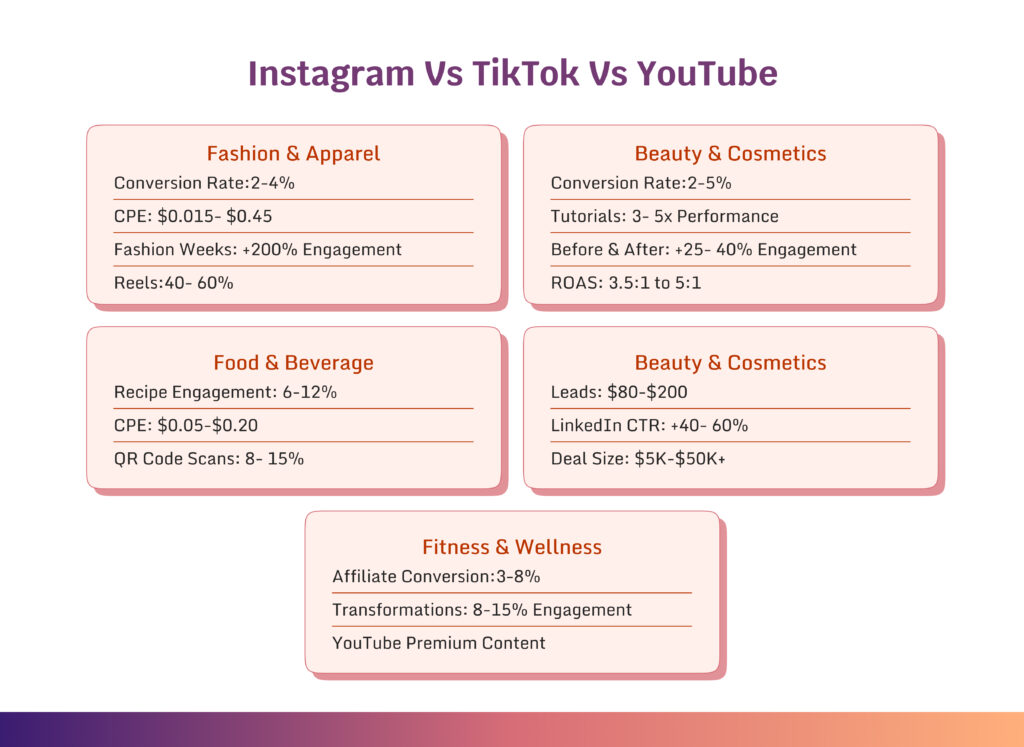
Each industry has its own numbers. Some sectors are becoming highly beneficial because of influencer marketing, while others aren’t getting much of it.
Fashion & Apparel
- Conversion rates: 2-4% average across influencer tiers
- CPE: $0.15-$0.45 depending on creator size
- Peak seasons: 200% engagement spike during fashion weeks (September, February)
- Instagram Reels: 40-60% higher engagement than feed posts (Drive Research)
Beauty & Cosmetics
- Conversion rates: 2-5% with tutorial content performing best
- Tutorial content: 3-5x performance vs simple product placement
- Before/after content: 25-40% higher engagement than standard posts
- ROAS: 3.5:1 to 5:1 average, making beauty one of the highest-ROI verticals (Archive)
Food & Beverage
- Recipe content: 6-12% engagement vs 2-4% for product placement alone
- CPE: $0.05-$0.20 (relatively low due to high engagement volume)
- QR code scan rates: 8-15% when integrated into influencer content
- Educational food videos do much better than short, passive “food shots.”
B2B Technology/SaaS
- Lead generation cost: $80-$200 per qualified lead via influencers
- LinkedIn outperforms YouTube by 40-60% for CTR to sales pages
- Average deal size: $5,000-$50,000+ influenced by tech creators
- Thought leadership content: 5-8x higher engagement than promotional content
Fitness & Wellness
- Affiliate conversion: 3-8% (highest across verticals) (Archive)
- Transformation content: 8-15% engagement rate
- YouTube is seen as premium for detailed, high-consideration content.
- Audience authenticity matters; many fitness influencers have fake followers.
What Drives Purchase Decisions in Influencer Marketing?
Every purchase is a multi-step journey. The user sees the product, saves or purchases it later.
Customers Trust Numbers
- People choose relatable influencers over corporate messaging any day. In fact, 86% consumers make influencer-inspired purchases annually (Archive).
- 49% do so monthly, weekly, or even daily! Influencer marketing is powerful because even celebrities don’t get as many conversions as influencers (Digital Marketing Institute).
It can be a tough world out there for B2B businesses trying to get into influencer marketing.
Find out the Top 10 B2B Influencer Marketing Agencies in 2026
Discover NowConversion Funnel Breakdown
- While a good 20-40% of sales happen within the same day of watching, 50-70% happen within 1-2 weeks.
- And the people who need a little persuasion can take more than 30 days. It’s important to have at least a 30+ days of measurement window for accurate ROI measurement.
The ROI Measurement Challenge (And How to Fix It)
Earlier, we mentioned that 53% of brands can’t track their influencer marketing ROI. It’s natural to wonder why, when there are so many advanced methods.
The answer is simple, actually. Their data is scattered across multiple platforms in a way that provides a confusing display of performance.
Especially when temporary ad placements (like Stories) disappear within 24 hours, it’s easy to lose track of incentives.
Besides, the fair multi-touch attribution adds another layer of complexity. Manual tracking can mess up terribly here.
The Four Popular Tracking Methods
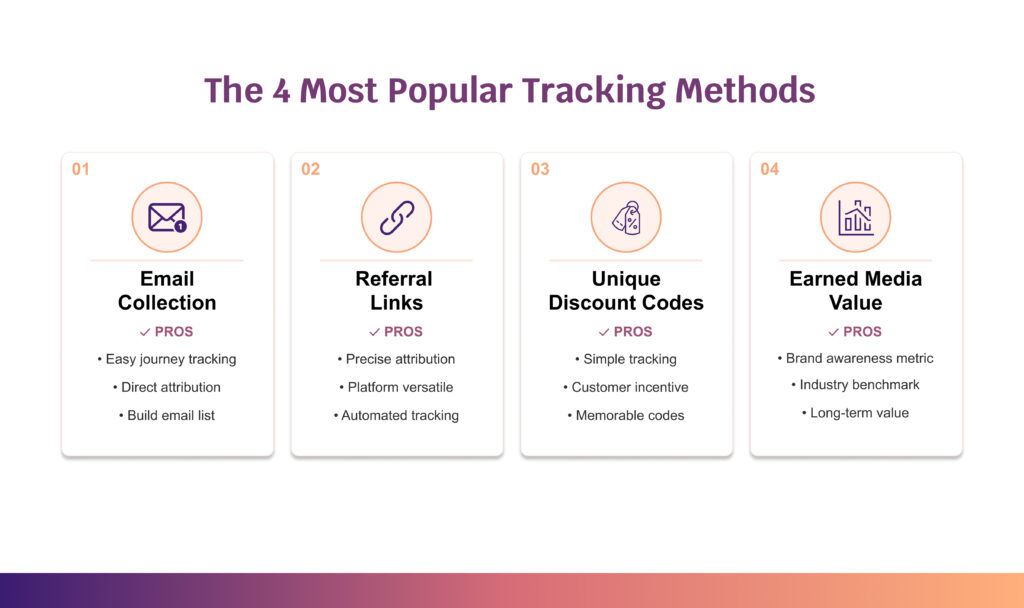
- ➜ Email collection: Customers submit their email to your website once inside, making it easy to track their journey.
- ➜ Referral links: Most used on TikTok and Instagram. You generate referral links with tracking codes that map each user to the proper attributors.
- ➜ Unique discount codes: Best used on YouTube, where the viewers are deeply familiar with the channel name. You give away discount codes customized to the name of the YouTuber you’re partnering with. The easiest method to keep track of attributors.
- ➜ EMV (Earned Media Value): You probably don’t know it by name, but it’s simple. Take the paid-ad equivalent cost and compare it to the reach you get organically through influencers. Create an industry-standard benchmark to measure campaign value beyond sales.
Technical Solutions That Already Exist
- ➜ UTM parameters let you track traffic sources precisely. Tag every influencer link with source, medium, and campaign identifiers.
- ➜ Pixel-based tracking has limits under GDPR and other privacy rules. Third-party cookies are dying; first-party data matters.
- ➜ AI-driven algorithms (like SocialMelo) that match brands to the best influencers with loyal audiences and all.
- ➜ CRM integration captures the full customer journey from awareness to purchase. Connect all touchpoints in one database.
- ➜ AI-powered attribution improves multi-touch modeling accuracy. Machine learning identifies true conversion patterns.
How AI and Automation Impact Influencer Marketing ROI
AI has been around for a while now, even before ChatGPT became public.
- 73% already believe that influencer marketing can be largely automated & 66.4% have reported better outcomes since using AI (Influencer Marketing Hub).
- So far, 60.2% brands use AI to find themselves the perfect match. SocialMelo has made it easier than ever to just sign up and get matched with suitable influencers in your niche. If you’re curious, we have flexible plans that suit every brand’s needs.
- In fact, 55.8% of businesses have adopted AI for influencer discovery already. So what are you waiting for?
How You Can Benefit From Influencer Marketing with AI
Algorithmic audience-overlap analysis improves creator-brand matching. AI spots creators whose followers match your ICP exactly.
- Faster campaign setup cuts discovery time by 20-30%. Less searching means quicker launches.
Better targeting reduces wasted spend on creators whose audiences don’t match your product.
Improved fraud detection protects your budget from bot-inflated accounts. AI spots patterns humans miss.
The Human Element Still Matters
- 89% avoid virtual influencers (Linqia), and so should you. Younger people are pros at detecting fake content from a mile away.
Authenticity standards are now higher than ever. Don’t make the mistake of collaborating with influencers who use AI to formulate their scripts or your product visuals in their videos.
Budget Allocation and Spending Trends for Maximum ROI
Most companies are used to making budgets for traditional or digital marketing, not influencer marketing. Since it varies budgeting by company size, it’s easy to feel like the budget is supposed to be arbitrary or experimental. However, there’s actually a clear way to budget for influencer marketing.
Recommended Budget Allocation by Growth Stage
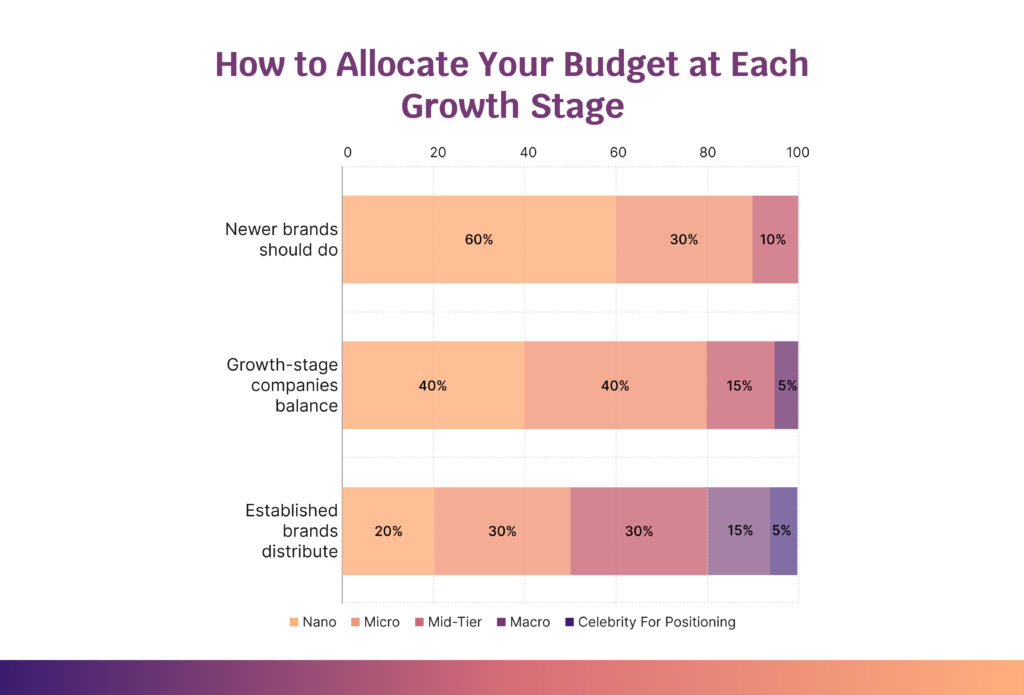
- ➜ Newer brands should do: 60% nano, 30% micro, 10% mid-tier for maximum conversion efficiency. Small budgets demand high-ROI creators.
- ➜ Growth-stage companies balance: 40% nano, 40% micro, 15% mid-tier, 5% macro. Blend reach with ROI.
- ➜ Established brands distribute: 20% nano, 30% micro, 30% mid-tier, 15% macro, 5% celebrity for positioning. Prestige matters alongside conversion.
Spending by Platform Priority
| Platform | Spend / Cost | Notes |
|---|---|---|
| $2.21B (U.S.) | Highest absolute spend; reflects established infrastructure. | |
| TikTok | $1.25B | Smaller total market, but offers the best perceived ROI per dollar. |
| YouTube | $1.07B | Highest cost, though the longest content lifespan justifies the investment. |
| Premium Pricing | Premium B2B pricing for qualified decision-maker access. |
- Instagram: Highest absolute spend ($2.21B U.S.) reflecting established infrastructure
- TikTok: Best perceived ROI per dollar but smaller total market ($1.25B)
- YouTube: Highest cost but longest content lifespan justifies investment ($1.07B)
- ➜ LinkedIn: Premium B2B pricing for qualified decision-maker access
The One Metric That Predicts Campaign Success Better Than Engagement
No, it’s not followers. You’ll rarely ever find any difference between 80% and 90% follower rates. What matters is if the creators have audience authenticity.
Not many experts talk about it, but high engagement rates don’t guarantee conversion rates unless quality is guaranteed.
How Do You Measure Audience Authenticity?
Look at their growth chart. If you see a steady 1-3% growth, that means they are building a loyal fanbase. It’s healthy organic growth.
If you see sudden spikes in following, they may be going viral for good/bad reasons. Good reasons don’t matter, but steer away from the ones with sudden downspikes, as they have lost audience trust lately.
If you see consistent engagement across commentary/talking videos? Green flag. Even better if they are close to the following count. If you’re checking for comments, make sure they are real humans (yes, memes count). Only emoji spams are red flags.
Lastly, check the geographic and demographic of their audience. There are no red/green flags here, just make sure that it’s the one you want to target.
Okay, but How Do I Do It Myself?
- ➜ Ask for detailed audience analytics with follower-quality scores.
- ➜ Check month-to-month engagement consistency for stability.
- ➜ Analyze comment quality manually (10-15 recent posts)
- ➜ Use verification tools like HypeAudience, Social Blade, and CreatorIQ for automation.
- ➜ Make sure their follower growth matches viral posts or campaign spikes.
Still confused about choices? Contact us for a free consultation!
Get Free ConsultationWhy This Matters More Than Other Metrics
Skeptic of this rather “vague” metric? Check out what’s worse:
- Shopify revealed that 25% influencers fake their following with bots.
- 9.5% Instagram accounts are bots (SociallyIn).
- Bot engagement drops conversion rates 40-60% despite showing up in metrics. It messes up your entire calculation because now you have no idea how much is fake/real.
- Authentic audiences convert 3-5x better than bot-inflated follower bases.
Long-Term Relationship ROI vs. One-Off Campaigns
The Trend Toward Continuity
- Once collaborations go well, 63.2% of brands continue working with the same influencers repeatedly (ClearVoice). This creates familiarity among the audience and sort of turns into an unofficial ambassador situation.
- 52% brands also focus on long-term campaigns instead of one-offs (Cropink) and 49% of influencers prefer ongoing partnerships as well (Dash.app)!
- In B2B, however, 58% use the always-on approach, meaning they handpick influencers to work with permanently and build their brand voice (Sprout Social). 99% B2B businesses rate it as highly effective.
Long-Term Partnership Advantages
You might still be wondering if long-term partnerships are really worth choosing over broad reach and diverse audiences. The answer is yes, it is worth it. BUT only if you’re an established brand with at least some recognition within the niche.
And if you are a mature brand, here’s why you should choose to work with influencers long-term:
- ➜ Creators who understand your product make more authentic content.
- ➜ The audience gets relevant commentary that adds further authenticity.
- ➜ You get an audience that already understands your product. Which means you can integrate TOFU, MOFU, & BOFU within your handpicked network.
- ➜ You get lent audience trust.
- ➜ Creators often offer discounts for multi-campaign contracts.
- ➜ Keeps the brand message consistent across a creator’s content calendar.
- ➜ Sustained brand exposure increases customer lifetime value.
Performance Comparison
We’re going to calculate the ROAS (Return On Ad Spend) in stages.
- ➜ Stage 1: One-off campaigns that get you 2-3x ROAS average baseline.
- ➜ Stage 2: 3-month partnerships that can 3-5x ROAS as familiarity builds.
- ➜ Stage 3: Partnering for a year brings 4-7x ROAS with optimized content and audience familiarity.
- ➜ Stage 4: Brand Ambassador or Always-on programs. Once committed, brands can get 5-8x ROAS from continuous presence and refinement.
Cost Efficiency Over Time
- Single posts cost $1,000-$5,000 for micro-influencers at standard market rates.
- 12-post annual contracts run $8,000-$40,000 total. That’s 20-35% savings compared to individual posts.
- But to get to that point, you need to run at least 3-4 campaigns with each influencer. Even if early posts cost more, later ones become cheaper, yet bring more ROI.
FAQs
How do I calculate influencer marketing ROI for my specific campaigns?
Divide total revenue by total campaign cost, multiply by 100. Include all fees, product costs, and management time in costs. Track revenue over 30-90 days minimum.
What’s a realistic ROI timeline for influencer campaigns?
Fast-moving consumer goods: 20-40% same-day, 50-70% within 7-14 days. B2B requires 60-180 days. Measure campaigns over 30-90 days minimum.
Which platform delivers the best influencer marketing ROI in 2026?
TikTok has the highest engagement (18%) and conversion (78%). Instagram leads spending ($2.21B) and brand preference (57.1%). YouTube is the best for education (70% conversion). Match platform to product type.
How much should I budget for my first influencer campaign?
Start with $5,000-$10,000. Work with 3-5 micro-influencers at $500-$2,000 each. This provides enough data to measure ROI without excessive risk.
Should I prioritize follower count or engagement rate?
Engagement rate predicts ROI better. 50k followers with 8% engagement outperforms 500k with 1%. Verify audience authenticity (80%+ score) before considering follower count.
How do I track ROI when customers don’t use discount codes?
Use UTM parameters on all links, collect emails with source attribution, enable pixel tracking where allowed, or ask customers at checkout, “How did you hear about us?”
What ROI should I expect from nano vs. macro influencers?
Nano (10k-100k): 4-7x ROAS at $100-$500/post with 8-12% engagement. Macro (10M+): 1.5-2.5x ROAS at $50k-$250k/post with 1-3% engagement. Choose nano for conversion, macro for reach.
Conclusion
When brands meet creators with their niche audience, influencer campaigns always outperform traditional ads. But you can increase it further by 20-40% if you use an AI-powered brand-influencer matching algorithm. Thus, you spend less and gain more ROI.
If you want to try influencer marketing for your next campaign, register on SocialMelo: Run a free audit and see projected ROI for your brand.